
Vybrané vedecké zdroje
a odborné východiská metódy PMMP
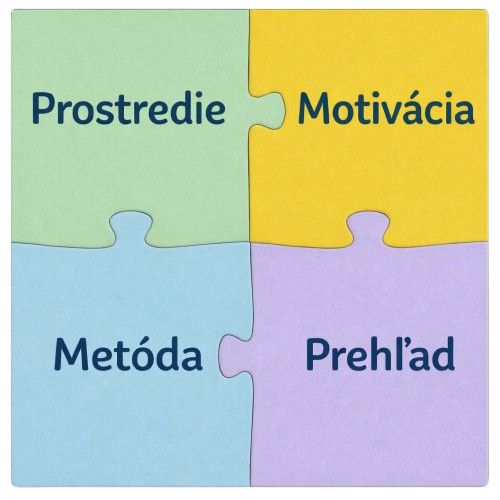
PMMP vychádza z poznatkov pedagogiky, psychológie učenia, neurovedy a kognitívnej vedy.
Nižšie uvádzame vybrané odborné zdroje, z ktorých jednotlivé piliere PMMP vychádzajú.
P
Prostredie
pilier Prostredie metódy PMMP
Hlavné vedecké zdroje
[1]
Klatte, M., Bergström, K., & Lachmann, T. (2013). Does noise affect learning? A short review of noise effects on cognitive performance in children. Frontiers in Psychology.
[2]
Barrett, P., Davies, F., Zhang, Y., & Barrett, L. (2015). The impact of classroom design on pupils' learning. Building and Environment.
https://doi.org/10.1016/j.buildenv.2015.02.013
[3]
Thapa, A., Cohen, J., Guffey, S., & Higgins-D'Alessandro, A. (2013). A Review of School Climate Research. Review of Educational Research.
[4]
Hattie, J. (2008). Visible Learning. Routledge.
https://www.visiblelearningmetax.com/influences
Doplnkové vedecké zdroje
Berkowitz, R., Moore, H., Astor, R.A., & Benbenishty, R. (2017). A Research Synthesis of the Associations Between Socioeconomic Background, Inequality, School Climate, and Academic Achievement. Review of Educational Research, 87(2), 425–469. journals.sagepub.com
Berman, M.G., Jonides, J., & Kaplan, S. (2008). The Cognitive Benefits of Interacting With Nature. Psychological Science, 19(12), 1207–1212. journals.sagepub.com
Csíkszentmihályi, M. (HarperCollins, 2008). Flow. 336 s.
Kaplan, S. (1995). The Restorative Benefits of Nature: Toward an Integrative Framework. Journal of Environmental Psychology, 15(3), 169–182. sciencedirect.com
Tanner, C.K. (2009). Effects of School Design on Student Outcomes. Journal of Educational Administration, 47(3), 381–399. emerald.com
Uline, C., & Tschannen-Moran, M. (2008). The Walls Speak: The Interplay of Quality Facilities, School Climate, and Student Achievement. Journal of Educational Administration, 46(1), 55–73. emerald.com
Wang, M.-T., & Degol, J.L. (2016). School Climate: A Review of the Construct, Measurement, and Impact on Student Outcomes. Educational Psychology Review, 28, 315–352. link.springer.com
M
Motivácia
pilier Motivácia metódy PMMP
Hlavné vedecké zdroje
[5]
Deci, E.L., & Ryan, R.M. (2000). Self-Determination Theory and the Facilitation of Intrinsic Motivation, Social Development, and Well-Being. American Psychologist, 55(1), 68–78. selfdeterminationtheory.org
[6]
Dweck, C.S. (2006). Mindset: The New Psychology of Success. Random House, New York. archive.org
[7]
Murayama, K., Matsumoto, M., Izuma, K., & Matsumoto, K. (2010). Neural basis of the undermining effect of monetary reward on intrinsic motivation. Proceedings of the National Academy of Sciences (PNAS), 107(49), 20911–20916. pnas.org
[8]
Gruber, M.J., Gelman, B.D., & Ranganath, C. (2014). States of Curiosity Modulate Hippocampus-Dependent Learning via the Dopaminergic Circuit. Neuron, 84(2), 486–496. cell.com
Doplnkové vedecké zdroje
Zelina, M. (Fontana, 1995). Sloboda osobnosti. 133 s. ISBN: 80-85701-07-3
Hidi, S., & Renninger, K.A. (2006). The Four-Phase Model of Interest Development. Educational Psychologist, 41(2), 111–127. doi.org
Patall, E.A., Cooper, H., & Robinson, J.C. (2008). The Effects of Choice on Intrinsic Motivation and Related Outcomes: A Meta-Analysis of Research Findings. Psychological Bulletin, 134(2), 270–300. psycnet.apa.org
M
Metóda učenia
pilier Metóda metódy PMMP
Hlavné vedecké zdroje
[9]
Sweller, J. (1988). Cognitive Load During Problem Solving: Effects on Learning. Cognitive Science, 12(2), 257–285. sciencedirect.com
[10]
Karpicke, J.D., & Roediger, H.L. III. (2008). The Critical Importance of Retrieval for Learning. Science, 319(5865), 966–968. science.org
[11]
Cepeda, N.J., Pashler, H., Vul, E., Wixted, J.T., & Rohrer, D. (2006). Distributed Practice in Verbal Recall Tasks: A Review and Quantitative Synthesis. Psychological Bulletin, 132(3), 354–380. pubmed.ncbi.nlm.nih.gov
[12]
Education Endowment Foundation (EEF). Teaching and Learning Toolkit. educationendowmentfoundation.org.uk
[121]
Bloom, S. Benjamin (1984). The 2 Sigma Problem: The Search for Methods of Group Instruction as Effective as One-to-One Tutoring. Educational Researcher, Vol. 13, No. 6, pp. 4–16. web.mit.edu
Doplnkové vedecké zdroje
Brown, P.C., Roediger, H.L. III, & McDaniel, M.A. (2014). Make It Stick: The Science of Successful Learning. Harvard University Press. archive.org
Chi, M.T.H., & Wylie, R. (2014). The ICAP Framework: Linking Cognitive Engagement to Active Learning Outcomes. Educational Psychologist, 49(4), 219–243. tandfonline.com
Dunlosky, J., Rawson, K.A., Marsh, E.J., Nathan, M.J., & Willingham, D.T. (2013). Improving Students' Learning With Effective Learning Techniques. Psychological Science in the Public Interest, 14(1), 4–58. journals.sagepub.com
Freeman, S., et al. (2014). Active Learning Increases Student Performance in Science, Engineering, and Mathematics. PNAS, 111(23), 8410–8415. pnas.org
Mayer, R.E., & Moreno, R. (2003). Nine Ways to Reduce Cognitive Load in Multimedia Learning. Educational Psychologist, 38(1), 43–52. doi.org
Rohrer, D., & Taylor, K. (2007). The Shuffling of Mathematics Problems Improves Learning. Instructional Science, 35, 481–498. link.springer.com
P
Prehľad
pilier Prehľad metódy PMMP
Hlavné vedecké zdroje
[13]
Wiliam, D. (2011). Embedded Formative Assessment. Solution Tree Press. archive.org
[14]
Hattie, J., & Timperley, H. (2007). The Power of Feedback. Review of Educational Research, 77(1), 81–112. journals.sagepub.com
[15]
Pane, J.F., Steiner, E.D., Baird, M.D., & Hamilton, L.S. (2015). Continued Progress: Promising Evidence on Personalized Learning. RAND Corporation. rand.org
[16]
van der Kleij, F.M., Feskens, R.C.W., & Eggen, T.J.H.M. (2015). Effects of Feedback in a Computer-Based Learning Environment on Students' Learning Outcomes: A Meta-Analysis. Review of Educational Research, 85(4), 475–511. journals.sagepub.com
Doplnkové vedecké zdroje
Black, P., & Wiliam, D. (1998). Assessment and Classroom Learning. Assessment in Education, 5(1), 7–74. tandfonline.com
Ferguson, R. (2012). Learning Analytics: Drivers, Developments and Challenges. International Journal of Technology Enhanced Learning, 4(5/6), 304–317. inderscienceonline.com
Nicol, D.J., & Macfarlane‐Dick, D. (2006). Formative Assessment and Self‐Regulated Learning: A Model and Seven Principles of Good Feedback Practice. Studies in Higher Education, 31(2), 199–218. tandfonline.com
Panadero, E. (2017). A Review of Self-Regulated Learning: Six Models and Four Directions for Research. Frontiers in Psychology, 8. frontiersin.org
Society for Learning Analytics Research (SoLAR). What is Learning Analytics? solaresearch.org
Zimmerman, B.J. (2002). Becoming a Self-Regulated Learner: An Overview. Theory Into Practice, 41(2), 64–70. tandfonline.com